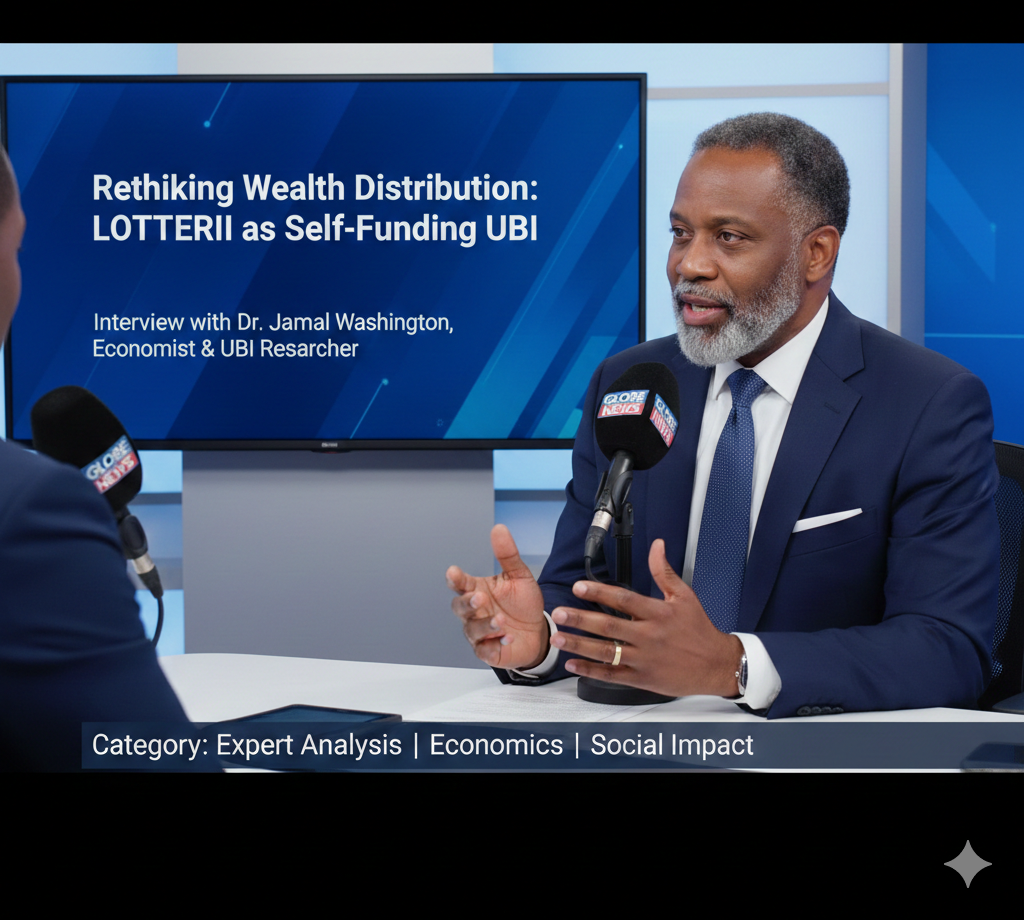
Dr. Jamal Washington has spent a decade researching Universal Basic Income models. When he discovered LOTTERII’s four-tier system, he saw something unprecedented: a self-funding mechanism for wealth redistribution that requires no government intervention. This conversation explores the economics of hope.
———
LOTTERII: Dr. Washington, you study Universal Basic Income. How does LOTTERII fit into that conversation?
Dr. Washington: LOTTERII isn’t technically UBI – it’s not universal, it’s not basic, and it’s not guaranteed income. But it’s solving the same core problem: wealth inequality and economic insecurity.
What fascinates me is that it’s completely voluntary and self-funding. Traditional UBI requires taxation, which creates political resistance. LOTTERII? People choose to participate. And the system redistributes wealth peer-to-peer.
How significant is the $100+ billion traditional lottery market?
In 2023, Americans spent over $105 billion on state lotteries. That’s more than they spent on movie tickets, music, porn, and sporting events combined. It’s massive.
But here’s the problem: those state lotteries take 35-40% off the top. They’re regressive taxes disguised as entertainment, disproportionately targeting low-income communities.
If LOTTERII can capture even 10% of that market with better odds and peer-to-peer structure, that’s $10 billion+ being redistributed more efficiently.
You mentioned regressive taxation. Explain that.
People earning under $30,000 a year spend about 5% of their income on lottery tickets. People earning over $100,000? Less than 1%.
So state lotteries are effectively taxing poor people at 5% of income to fund government programs. That’s textbook regressive taxation.
LOTTERII’s 73% SPARK win rate changes that dynamic. Instead of losing 5% of income, low-income players might actually net positive. That’s transformative.
How does the four-tier system function economically?
It’s brilliant wealth redistribution. Let me explain:
SPARK ($3) creates frequent small winners. This keeps low-income players engaged without devastating losses.
TITAN ($5) creates new millionaires regularly. Construction workers, drivers, service workers – people who’d never access that wealth otherwise.
LEGEND ($7) and BEAST ($15) create generational wealth for a select few, but the entry costs mean primarily higher-income players chase these.
So you’ve got a progressive system where the wealthy chase BEAST while the working class consistently wins on SPARK. That’s economically elegant.
What about AI and job displacement? You’ve written about this.
We’re heading toward a world where 30-40% of current jobs could be automated in the next 15 years. That creates a massive need for income redistribution mechanisms.
Government UBI faces political gridlock. But a voluntary, self-funding system like LOTTERII? That could actually work.
Imagine: automation displaces truck drivers. But those drivers can participate in SPARK for consistent supplemental income, with shots at TITAN for complete financial reset. No government approval needed.
Is this sustainable long-term?
If it’s truly peer-to-peer with minimal overhead? Yes. The mathematics work when you remove the government middleman taking 40%.
Traditional lotteries are zero-sum extraction. LOTTERII appears to be positive-sum redistribution. That’s the difference between parasitic and symbiotic systems.
What’s your prediction for impact?
If LOTTERII captures 20% of the lottery market by 2030, that’s roughly $20 billion being redistributed more efficiently. At 73% payout rates vs 60%, that’s billions more going to players than under the current system.
More importantly, it shifts the narrative. Instead of lotteries being exploitative poverty taxes, they become actual wealth redistribution mechanisms.
That’s not just economic. That’s social transformation.
Bottom line: Is LOTTERII good for society?
From an economic perspective? Unequivocally yes. It’s more efficient wealth redistribution than state lotteries. It’s voluntary participation unlike taxation. And it creates real economic mobility through achievable odds.
We desperately need new models for economic security. LOTTERII might be one of them.